Canceled Expos
The Expos that never opened
Winning the right to host an Expo is only the start. Since the 1928 Convention, several Expos chosen for a host city were called off before opening day, undone by politics, voters and money. This page gathers the cases we have been able to document.
01
Why Expos are canceled
An Expo takes about a decade to prepare. In that time, the host country must secure funding, land and transport, keep the support of its own government and persuade other countries to take part. Under the Convention Relating to International Exhibitions of 1928, the International Exhibitions Bureau (Bureau International des Expositions, BIE) grants the right to organize an Expo, but the host government carries the risk.
The cases on this page share a few patterns: political opposition or a change of government (Expo 1989 Paris, Expo 1996 Budapest), cost and funding problems (Expo 1967 Moscow, Expo 1981 Los Angeles, Expo 1992 Chicago, Expo 2023 Buenos Aires), a public vote (Expo 1995 Vienna-Budapest) and war (Expo 1942 Rome). Twice, another host stepped in or carried on: Montreal took over 1967, and Seville held its 1992 Expo alone.
02
Awarded, then called off
Expo 1942 Rome
Italy first asked for 1941. On November 11, 1935, a month after it invaded Ethiopia, its ambassador in Paris, Vittorio Cerruti, informed the BIE that the government planned a world and universal exhibition in Rome, and Italy applied to reserve the year for a general exhibition of the first category. The 1928 Convention allowed one exhibition of that category every six years, and Expo 1935 Brussels had opened the cycle. Italy offered 200 to 250 hectares (about 500 to 620 acres) between Rome and the sea, where each nation could build its own pavilions. According to Italy’s Central State Archives, the formal application went to the BIE in June 1936 and was approved within days.
A law of December 26, 1936, created an autonomous agency for the Expo, now set for 1942, the 20th year of the Fascist regime. Senator Vittorio Cini became commissioner general, and the theme was “Olimpiadi della Civiltà,” the Olympics of Civilization. A planning commission laid out a new district at Tre Fontane, on the road to Ostia, and about 400 hectares (990 acres) were expropriated in 1938. A Spanish architecture journal reported in 1941 that the Expo was to open on April 21, 1942, and that Germany, France and Britain had reserved plots, while other countries, among them the United States, Brazil and Japan, were preparing to take part. Most of the buildings finished before the war reinterpreted Roman classicism; a curved reinforced concrete pavilion proposed by the engineer Pier Luigi Nervi was never built.
The international crisis of 1939 brought foreign withdrawals, rising costs and shortages. Italy entered World War II on June 10, 1940, and the Expo was postponed indefinitely. Cini proposed moving it to 1944 or 1947, or turning it into a national or continental exhibition, but in February 1943 the agency passed to the Governorate of Rome, and its ordinary administration was dissolved at the end of 1944. The unfinished district, later called EUR, was completed after the war.
Sources differ on some dates. Maurice Isaac, the BIE’s first director, prints Italy’s November 1935 request for 1941, while the Italian archives date the formal application to June 1936. Some secondary sources say the BIE registered the Expo in April 1938; we have not found that decision in a BIE source. The New York Times reported the postponement on June 4, 1940, while the Italian archives place the decision about a week after Italy entered the war on June 10.
Expo 1967 Moscow
The Soviet Union planned an Expo in Moscow for 1967, the 50th anniversary of the October Revolution of 1917. On May 5, 1960, the BIE chose Moscow over bids from Austria and Canada to host a general exhibition of the first category. The Soviet Union had already presented its economy, science and culture in national pavilions at Expo 1937 Paris, Expo 1939 New York and Expo 1958 Brussels, where Expos also served as a stage for Cold War rivalry. Hosting the whole Expo in its own capital would have taken that contest a step further, with countries from rival political and economic systems exhibiting on Soviet soil.
On April 13, 1962, the Soviet Union announced that it was giving up the Expo. The Montreal city archive says Moscow cited financial difficulties, while Le Monde, reporting the announcement on April 16, 1962, gave the official reason as the nearness of the large exhibition planned in New York for 1964 and 1965, which the BIE did not sanction. One historian describes the decision as an indefinite postponement. No single explanation is shared by all accounts of the time.
The withdrawal gave Canada a second chance, since its Confederation would turn 100 in 1967. Montreal's mayor, Jean Drapeau, pressed for a new Canadian bid and won over Prime Minister John Diefenbaker. On November 13, 1962, the BIE voted unanimously for the Canadian bid. Montreal then had four and a half years to prepare, and Expo 1967 Montreal opened on April 28, 1967. It was a new award, with its own organization and site, not the transfer of an Expo already under construction. The Soviet Union took part in Montreal with its own pavilion, so losing the role of host did not take it out of the Expo circuit.
Expo 1981 Los Angeles
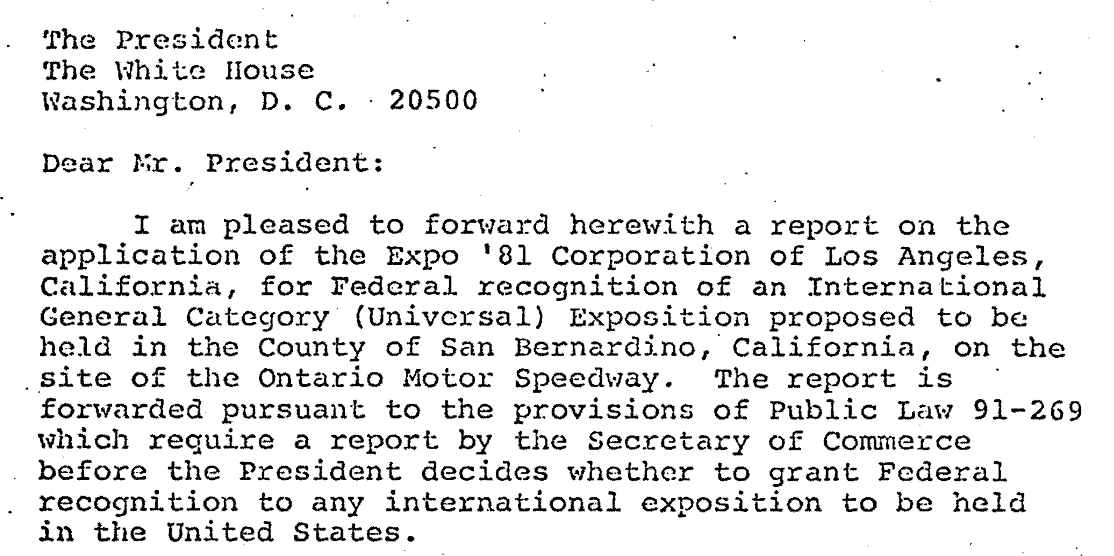
Los Angeles planned a general exhibition of the first category to mark the 200th anniversary of the city's founding in 1781, to run from May 1 to November 1, 1981 (one source gives May 2 to November 2), on the theme “People to People: Pathways to Understanding.” Its private organizer, Expo 81 Incorporated, was formed by Los Angeles businessmen around 1974 and led by Richard M. Pittenger. It ruled out sites such as Griffith Park, the Sepulveda Dam Basin and the Pomona Fairgrounds and chose the Ontario Motor Speedway in Ontario, San Bernardino County, about 61 kilometers (38 miles) east of downtown Los Angeles. The racetrack offered about 280 hectares (nearly 700 acres), seating for 92,000 spectators and parking for 46,000 cars, about 400 meters (a quarter mile) from Ontario International Airport.
Under U.S. law, the federal government had to recognize the Expo before the BIE could register it. The organizers applied on March 28, 1976, and on April 23, 1976, Secretary of Commerce Elliot L. Richardson named the speedway the U.S. choice for 1981. Earlier that year, his department had turned down Knoxville's request for a 1980 Expo in favor of Los Angeles; Knoxville applied again and later held Expo 1982 Knoxville. On April 27 or 28, 1976 (sources disagree on the date), the BIE accepted the proposed dates. On November 15, 1976, Richardson recommended recognition on conditions: a final environmental impact statement, California's approval of a planned $35 million bond issue and the rest of the financing. His department put the cost of U.S. participation at $25 million to $40 million and noted that the company was run largely by one person, with little oversight from its board. On November 17, 1976, the BIE's 38 member states voted unanimously to register the Expo once it received federal recognition, and President Gerald R. Ford granted that recognition on December 20, 1976, calling the Expo “a cornerstone marking the beginning of America's Third Century.”
By September 1977, the investment bank Bear, Stearns & Co. had prepared a plan to issue $133 million in tax-exempt revenue bonds, and the Ontario City Council had approved leasing the speedway. Still, the organizers could not secure the public financing that U.S. law required. On December 12, 1977, Secretary of Commerce Juanita M. Kreps wrote that she would not recommend that the president invite other nations to take part “at this time,” and the United States announced that it would not take part either. The organizers came back with a $90 million plan, but on May 1, 1978, the deadline for the invitations, Kreps recommended against the invitations and against federal recognition, citing too few committed funds, the likely need for public money and the lack of support from residents and elected officials. President Jimmy Carter's staff said a reversal was extremely unlikely, and the Expo never took place.
Expo 1989 Paris
On September 24, 1981, President François Mitterrand told a press conference that he had opened talks to secure a universal exhibition for France in 1989, the bicentennial of the French Revolution and the centenary of Expo 1889 Paris. On November 20, 1981, he entrusted Robert Bordaz with a study mission for an Expo on the theme “Les chemins de la liberté” (The Paths of Liberty). The plan needed a change to the international rules: a 1982 amendment, adopted at the French government's initiative, shortened the 10-year interval required between universal exhibitions. The BIE gave France an agreement in principle in June 1982 and confirmed it on December 8, 1982, in the same decision that set aside 1992 for the candidacies of Seville and Chicago. These are two steps of one process, not conflicting dates.
The city's position was not outright opposition from the start. On March 31, 1982, Paris Mayor Jacques Chirac accepted the principle of the Expo in a letter to Bordaz, on condition that it neither delay the city's own urban projects nor add to its financial burden. As planning advanced, the government and the city could not overcome their differences. In June 1983, a Senate special committee warned of a worrying gap between the project's costs and revenues and of the lack of procedures to control them.
The bill to create the Expo went through Parliament in the spring of 1983. The National Assembly sent it to the Senate in May, a joint committee of both chambers failed to agree on June 28, 1983, and the bill went back for further readings. In early July 1983, Mitterrand announced that France was giving up the Expo, blaming the hostility of the Paris authorities, and the law was never promulgated. The cancellation came six years before the anniversary, so the Expo never had participating countries or visitors.
Not every project linked to 1989 stopped with the Expo. Mitterrand had announced the Opéra Bastille on March 8, 1982. Carlos Ott's design won the international competition in November 1983, foundation work began in February 1985, and the opera house opened on July 13, 1989, on the eve of the bicentennial. It followed its own path and was never an Expo pavilion.
Expo 1992 Chicago
Chicago planned an Expo for 1992, the 500th anniversary of Christopher Columbus's voyage of 1492, building on the city's experience with Expo 1893 Chicago and Expo 1933 Chicago. Talks began in the early 1980s, under Mayor Jane Byrne, for what was to be called the “Age of Discovery International Exposition.” On December 8, 1982, the BIE set aside 1992 for the candidacies of Chicago and Seville, and the two went forward as one Expo held in two countries. On June 27, 1984, President Ronald Reagan issued Proclamation 5215 on the “1992 Chicago-Seville International Exposition,” whose theme, “The Age of Discovery,” was to cover the social, economic, scientific and cultural changes since 1492 and the discoveries still to come.
The site was about 192 hectares (475 acres) on the lakefront of the Near South Side, south of the Loop. Neighborhood groups feared that the Expo would concentrate public money there, push up rents in nearby neighborhoods and draw investment away from other parts of the city. A citywide coalition, the Chicago 1992 Committee, questioned how openly the plans were made and pushed for studies and public hearings on cost, public risk and who would benefit. Harold Washington, mayor from 1983, stayed neutral at first.
Cost estimates rose toward $1 billion, Chicago and the state of Illinois could not agree on who would guarantee the funds, and the bankruptcy of Expo 1984 New Orleans weighed on public opinion. In June 1985, the Illinois legislature refused to fund further planning, and with little united support left, Washington let the project die. Seville went on alone and held Expo 1992 Seville. In Chicago, the canceled Expo kept feeding debates on who decides, who pays and who benefits from large urban projects; in October 1991, the Chicago Institute for Architecture and Urbanism devoted a two-day event to it and to Expo 1893 Chicago.
Expo 1995 Vienna-Budapest
On September 29, 1987, Austrian Chancellor Franz Vranitzky and Károly Grósz, chairman of Hungary's Council of Ministers, signed a government declaration committing both countries to a joint Expo in 1995, under the theme “Bridges to the Future.” The idea predated the fall of the Berlin Wall, and the changes of 1989 turned it into a symbol of a Europe no longer divided. On May 25, 1989, the BIE accepted the candidacy after Miami, the last remaining rival, withdrew. On December 14, 1989, it awarded the Expo to Vienna and Budapest for April 29 to October 26, 1995, and on December 12, 1990, it granted a conditional registration, pending a joint marketing company and the details of the financing. It would not have been the first Expo planned in two countries: the United States had already announced the 1992 Chicago-Seville Expo in those terms in 1984.
Austria set up EXPO-VIENNA AG in 1989, owned by the federal government and the City of Vienna, to plan, finance, build and coordinate the Expo and to manage the later use of its site. On April 10, 1991, the Vienna City Council called a citizens' vote on the Expo. Supporters described it as a once-in-a-millennium chance for Vienna to keep pace with change in Berlin, Prague and Budapest, while others questioned Hungary's ability to pay its share; one councillor said Vienna could hold the Expo alone if Budapest withdrew.
The vote took place from May 14 to 16, 1991. Turnout was 43.70%, and 64.85% voted against holding the Expo in Vienna, while the same ballot approved the Freudenau hydroelectric plant on the Danube. Such votes are not legally binding in Vienna, but city leaders accepted the result the next day, and Vice Mayor Hans Mayr proposed ending the project and dissolving its institutions. Austria officially withdrew Vienna's bid in June 1991, and Budapest carried on alone with a new Expo for 1996.
Expo 1996 Budapest
After Austria withdrew, Budapest went on with an Expo of its own: a specialized exhibition from May 11 to October 4, 1996, marking 1,100 years since the Hungarians settled in the Carpathian Basin, on the theme “Communication for a Better World.” The BIE accepted the new plan on December 4, 1992, and in 1994 the European Commission described it as a specialized exhibition registered with the BIE. The theme spanned the history of communication, from printing, the telephone, radio, film and television to computing and satellites, along with languages, translation, teaching and dialogue between people and nations.
The site covered 44 hectares (about 109 acres) along the Danube in southern Budapest, in a renewal area next to university grounds, and the universities were to inherit its permanent buildings. Funding fell short, real estate sales meant to pay for the site disappointed, and work fell behind.
After the 1994 elections, the new government of Prime Minister Gyula Horn decided on July 28, 1994, not to go ahead. Horn announced a bill to make the cancellation law and said that buildings already under construction would be finished. Parliament then passed Act LXX of 1994 on renouncing “EXPO '96 Budapest.” Its preamble cited the country's grave economic situation and the need to cut public spending, and its first article stated that the Expo would not be held. The act directed the investments on the site toward higher education and the capital's development, and turned the related programs into a national program for tourism and local communities.
The wind-up went on for years. In May 1996, a government resolution created an information technology and innovation park on state land first set aside for the Expo, with an agreement to protect the interests of the Budapest University of Technology and Economics (BME) and Eötvös Loránd University (ELTE). The prepared grounds went on to host ELTE's Lágymányos campus, the Infopark and later the Millennium City Center, so the canceled Expo shaped this part of Budapest without ever receiving visitors.
Expo 2023 Buenos Aires
On November 15, 2017, the BIE member states elected Argentina to host a recognized Expo in Buenos Aires from January 15 to April 15, 2023, on the theme “Science, Innovation, Art and Creativity for Human Development. Creative Industries in Digital Convergence.” The vote went to two rounds. In the first, Argentina and Poland received 46 votes each and the United States 25, with one abstention; in the second, Argentina won with 62 votes to Poland's 56. The rival bids came from Łódź and Minnesota. It would have been the first Expo in South America.
Preparations moved forward. In June 2018, Gabriela Ricardes reported to the BIE General Assembly on work on the site and contacts with future participants, and said Argentina expected to file its recognition dossier in early 2019. The Expo was to occupy 25 hectares (about 62 acres) of the Tecnópolis park, north of the city. On May 17, 2019, the government launched six international ideas competitions for its buildings, with the site to become a metropolitan park for science and knowledge and a campus for creative industries afterward; organizers forecast about nine million visits. On August 14, 2019, it announced the winners for the Argentine Pavilion and for the Antenna and Lookout, a 125-meter (410-foot) telecommunications tower.
On October 14, 2020, La Nación reported that the government had told the BIE that the COVID-19 pandemic and the economic crisis kept it from starting construction and from confirming the Expo as planned. Media Secretary Francisco Meritello left open the possibility of negotiating a much smaller exhibition. In October 2021, El Cronista reported that the government had suspended the project. The Expo did not open in 2023.
03
What happens after a cancellation
A canceled Expo leaves more than empty plans. Rome kept the unfinished district that became EUR, Budapest gained buildings it reused, Montreal gained an Expo it had first lost, and Seville held alone the Expo it had planned to share. None of these Expos appears on the BIE's lists of Expos, which count only the Expos that opened.
04
Bibliography
Archivio Centrale dello Stato. “Ente autonomo esposizione universale Roma - EUR E 42.” Accessed November 14, 2026. https://search.acs.beniculturali.it/OpacACS/authority/IT-ACS-SP00001-00000187.
Barlow, Julie, and Jean-Benoît Nadeau. “Mission Impossible.” Canada’s History, June 1, 2017. https://www.canadashistory.ca/explore/arts-culture-society/mission-impossible.
Beau, Camille. “Paris, 1989 : la France annule son grand projet d’Exposition Universelle.” Paris ZigZag. Last modified December 16, 2020. https://www.pariszigzag.fr/insolite/histoire-insolite-paris/paris-1989-la-france-annule-son-grand-projet-dexposition-universelle/.
Bureau International des Expositions. “162nd General Assembly of the BIE.” November 15, 2017. https://bie-expo.bie-paris.org/site/en/news-announcements/bie-activity/162nd-general-assembly-of-the-bie.
Bureau International des Expositions. “163rd General Assembly of the BIE.” June 2018. https://db.bie-paris.org/site/en/news-announcements/bie-activity/163rd-general-assembly-of-the-bie.
Bureau International des Expositions. “Argentina Elected Host Country of Specialised Expo 2023.” November 15, 2017. https://81.bie-paris.org/site/en/news-announcements/bie-activity/argentina-elected-host-country-of-specialised-expo-2023.
Bureau International des Expositions. “Specialised Expo.” Accessed November 12, 2026. https://www.bie-paris.org/site/en/expo-index/all-specialised-expos.
Bureau International des Expositions. “World Expos.” Accessed November 12, 2026. https://www.bie-paris.org/site/en/expo-index/all-world-expos.
Chabay, Ezequiel M. “El Gobierno suspendió la organización de un evento global que había prometido realizar Macri.” El Cronista, October 23, 2021. https://www.cronista.com/economia-politica/el-gobierno-suspendio-la-organizacion-de-un-evento-global-que-habia-prometido-realizar-macri.
Chappell, Urso. “The Expo 92 That Didn’t Happen.” Urso Chappell’s ExpoMuseum Blog, May 18, 2007. https://ursochappell.blogspot.com/2007/05/expo-92-that-didnt-happen-this-week-i.html.
Chicago History Museum. “World’s Fairs.” Research guide. Accessed November 14, 2026. https://libguides.chicagohistory.org/c.php?g=645119&p=4520892.
“Chicago’s World’s Fairs of 1893 and 1992.” Chicago Institute for Architecture and Urbanism, October 24–25, 1991. SOM Foundation. https://somfoundation.com/events/chicagos-worlds-fairs-of-1893-and-1992/.
“Commerce Secretary against Ontario Fair.” Associated Press. Thousand Oaks Star, May 2, 1978. https://cdnc.ucr.edu/?a=d&d=TOKS19780502-02.1.2.
“Concurso Internacional de Ideas de Arquitectura: Expo 2023 Argentina Buenos Aires.” Argentina.gob.ar, May 17, 2019. https://www.argentina.gob.ar/noticias/concurso-internacional-de-ideas-de-arquitectura-expo-2023-argentina-buenos-aires.
Cooper, Steve. “‘World’ Approval: Expo 81 Clears Hurdle.” San Bernardino Sun-Telegram, November 18, 1976. https://cdnc.ucr.edu/?a=d&d=SBS19761118.1.1.
Demokratiezentrum Wien. “Beispiele direkter Demokratie: Wiener Volksbefragung.” Accessed November 14, 2026. https://www.demokratiezentrum.org/bildung/ressourcen/themenmodule/direkte-demokratie/direkte-demokratie-in-wien/beispiele-direkter-demokratie-wiener-volksbefragung/.
European Commission. Communication from the Commission to the Council and the European Parliament: Participation of the European Union in the Budapest International Exposition. COM(94) 348 final. July 27, 1994. https://eur-lex.europa.eu/legal-content/EN/TXT/PDF/?uri=CELEX%3A51994DC0348.
Expo 81 Incorporated. “Expo 81: A Progress Report.” September 1977.
Expo 81 Incorporated. “Status Report.” February 1977.
EXPO-VIENNA AG. EXPO ’95 in Wien und Budapest: Schlußbericht. Vienna, July 1991. https://austria-forum.org/attach/AEIOU/Weltausstellung_in_Wien/Schlussbericht.pdf.
Feit, Harvey. “Major Defeat Inflicted on Expo ’81: Financing Lag Kills Participation by U.S.” San Bernardino Sun-Telegram, December 14, 1977. https://cdnc.ucr.edu/?a=d&d=SBS19771214.1.1.
Ford, Gerald R. “Statement Announcing Federal Recognition of ‘Expo ’81’ as a World’s Fair.” December 20, 1976. The American Presidency Project. https://www.presidency.ucsb.edu/node/257707.
“French President Scuttles Plan for a World’s Fair.” Christian Science Monitor, July 6, 1983. https://www.csmonitor.com/1983/0706/070621.html.
Gerald R. Ford Presidential Library. “Expo ’81.” Box 14, James M. Cannon Files. https://www.fordlibrarymuseum.gov/LIBRARY/document/0039/1515832.pdf.
“Hungary Cancels World Expo.” United Press International, July 28, 1994. https://www.upi.com/Archives/1994/07/28/Hungary-cancels-World-Expo/9867775368000/.
Hungary. “1046/1996. (V. 15.) Korm. határozat az Informatikai és Technológiai Innovációs Park létesítéséről.” May 15, 1996. Nemzeti Jogszabálytár. https://njt.jog.gov.hu/jogszabaly/1996-1046-30-22.
Hungary. “1994. évi LXX. törvény az „EXPO ’96 Budapest” nemzetközi szakkiállítás megrendezésének lemondásáról.” 1994. Nemzeti Jogszabálytár. https://njt.jog.gov.hu/jogszabaly/1994-70-00-00.
Isaac, Maurice. Les expositions internationales. Paris: Librairie Larousse, 1936.
“Italy Postpones 1942 World’s Fair; Decision Viewed as Assuring Early Entry into the War.” New York Times, June 4, 1940. https://www.nytimes.com/1940/06/04/archives/italy-postpones-1942-worlds-fair-decision-viewed-as-assuring-early.html.
Izsák, Éva, and Pál Szabó, eds. Budapest 150: Tanulmányok a főváros jubileumára. Budapest: ELTE Természettudományi Kar, 2023. https://ttk.elte.hu/sites/default/files/TTK/documents/2025-12/Izsak%20Eva-Szabo%20Pal_Budapest%20foldje%20webre.pdf.
Knight, Robert. “In Chicago, Prospect for a World’s Fair in ’92 Meets Skepticism.” Christian Science Monitor, December 3, 1984. https://www.csmonitor.com/1984/1203/120345.html.
“L’enfant du divorce.” Le Monde, July 7, 1983. https://www.lemonde.fr/archives/article/1983/07/07/l-enfant-du-divorce_2837893_1819218.html.
La Roche, Roger. “Expo 67. Cette fois-ci, c’est la bonne!” Encyclopédie du MEM, Centre des mémoires montréalaises, April 26, 2017. https://ville.montreal.qc.ca/memoiresdesmontrealais/expo-67-cette-fois-ci-cest-la-bonne.
Lambert, Maude-Emmanuelle. “Expo 67.” The Canadian Encyclopedia. Historica Canada. Published February 7, 2006; last modified November 24, 2023. https://www.thecanadianencyclopedia.ca/en/article/expo-67.
Le Roux, Bruno. Rapport d’information fait au nom de la mission d’information sur la candidature de la France à l’exposition universelle de 2025. Assemblée nationale, no. 2325. October 28, 2014. https://www.assemblee-nationale.fr/14/rap-info/i2325.asp.
Lloyd, Jim. “What Is Expo ’81.” Congressional Record 122, pt. 20 (July 30, 1976): 24822–24823. https://www.govinfo.gov/content/pkg/GPO-CRECB-1976-pt20/pdf/GPO-CRECB-1976-pt20-1-3.pdf.
López César, Isaac. World Expos: A History of Structures. Translated by Rebecca S. Ramanathan. Barberà del Vallès, Barcelona: By Architect Publications, 2017.
Metz, Leonard. “World’s Fair Site Approval.” San Bernardino Sun-Telegram, April 24, 1976. https://cdnc.ucr.edu/?a=d&d=SBS19760424.1.16.
Mitterrand, François. “Lettre de M. François Mitterrand, Président de la République, à M. Robert Bordaz, président de l’Union centrale des arts décoratifs, sur la préparation de l’Exposition universelle de 1989.” November 20, 1981. Élysée. https://www.elysee.fr/francois-mitterrand/1981/11/20/lettre-de-m-francois-mitterrand-president-de-la-republique-a-m-robert-bordaz-president-de-lunion-centrale-des-arts-decoratifs-sur-la-preparation-de-lexposition-universelle-de-1989-paris-vendredi-20-novembre-1981.
“No Carter Ruling Yet on Expo ’81.” San Bernardino Sun-Telegram, May 3, 1978. https://cdnc.ucr.edu/?a=d&d=SBS19780503.1.33.
“OMS Fair Passes Key Test.” San Bernardino Sun-Telegram, April 29, 1976. https://cdnc.ucr.edu/?a=d&d=SBS19760429.1.30.
Opéra national de Paris. “Opéra Bastille.” Accessed November 14, 2026. https://www.operadeparis.fr/apropos/theatres-et-ateliers/opera-bastille.
“Pas d’exposition internationale en 1967, confirme Moscou.” Le Monde, April 16, 1962. https://www.lemonde.fr/archives/article/1962/04/16/pas-d-exposition-internationale-en-1967-confirme-moscou_2370513_1819218.html.
Ranney, David C., Patricia A. Wright, and Tingwei Zhang. Citizens, Local Government and the Development of Chicago’s Near South Side. Discussion Paper 90. Geneva: United Nations Research Institute for Social Development, 1997. https://www.files.ethz.ch/isn/28888/dp90.pdf.
Reagan, Ronald. “Proclamation 5215: 1992 Chicago-Seville International Exposition.” June 27, 1984. The American Presidency Project. https://www.presidency.ucsb.edu/documents/proclamation-5215-1992-chicago-seville-international-exposition.
Revista Nacional de Arquitectura, no. 4 (1941): 51–57. https://www.coam.org/media/Default%20Files/fundacion/biblioteca/revista-arquitectura-100/1941-1946/docs/revista-articulos/revista-nacional-arquitectura-1941-n04-pag51-57.pdf.
Romani, Roger. Rapport fait au nom de la commission mixte paritaire chargée de proposer un texte sur les dispositions restant en discussion du projet de loi sur l’Exposition universelle de 1989. Sénat, no. 450, seconde session ordinaire de 1982-1983. 1983. https://www.senat.fr/rap/1982-1983/i1982_1983_0450.pdf.
Romani, Roger. Rapport fait au nom de la commission spéciale sur le projet de loi, adopté par l’Assemblée nationale, sur l’Exposition universelle de 1989. Sénat, no. 389, seconde session ordinaire de 1982-1983. June 14, 1983. https://www.senat.fr/rap/1982-1983/i1982_1983_0389.pdf.
“Se eligieron los proyectos ganadores del Pabellón Argentino y de la Antena y Mirador para la Expo 2023.” Argentina.gob.ar, August 14, 2019. https://www.argentina.gob.ar/noticias/se-eligieron-los-proyectos-ganadores-del-pabellon-argentino-y-de-la-antena-y-mirador-para.
Soria Guadalupe, Alan. “La Argentina se bajó de la organización y no será sede de la Expo Mundial 2023, un megaevento de impacto global.” La Nación, October 14, 2020. https://www.lanacion.com.ar/politica/la-argentina-se-bajo-no-sera-sede-nid2479377/.
Stadt Wien. “Stellungnahmen zum Ergebnis der Volksbefragung.” Rathauskorrespondenz, May 17, 1991. https://presse.wien.gv.at/presse/1991/05/17/stellungnahmen-zum-ergebnis-der-volksbefragung.
Stadt Wien. “Wiener Gemeinderat (4).” Rathauskorrespondenz, April 10, 1991. https://presse.wien.gv.at/presse/1991/04/10/wiener-gemeinderat-4.
Swift, Anthony. “The Soviet Union at the 20th-Century World’s Fairs.” World History Connected 13, no. 3 (October 2016). https://journals.gmu.edu/whc/article/download/4079/2281?inline=1.
U.S. Department of Commerce. “Transition Reports (1977) - Commerce Department: Consolidated Issues (5).” Box 34, John Marsh Files, Gerald R. Ford Presidential Library. https://www.fordlibrarymuseum.gov/library/document/0067/7773978.pdf.
U.S. Department of Commerce. “Transition Reports (1977) - Commerce Department: U.S. Travel Service (2).” Box 36, John Marsh Files, Gerald R. Ford Presidential Library. https://www.fordlibrarymuseum.gov/library/document/0067/7774083.pdf.
Vorarlberger Landesregierung. “16. Bericht über die Lage des Föderalismus in Österreich (1991).” Regierungsvorlage, Beilage 7/1993 zu den Sitzungsberichten des XXV. Vorarlberger Landtages. Bregenz, January 27, 1993. https://agi-imc.de/VLR/VLR_gov.nsf/0/B26831B293EBBF38C1257BDC003190DA/%24FILE/7_1993_Regierungsvorlage_19930000.pdf.
Woodard, Colin. “Hungary’s 1996 World Expo May Be a No-Go.” Christian Science Monitor, September 29, 1993. https://www.csmonitor.com/1993/0929/29092.html.