Past Expo
Expo 1889 Paris
May 6 to October 31, 1889
Theme: Celebration of the centenary of the French revolution
Pre-Convention
Add paragraph text. Click “Edit Text” to update the font, size and more. To change and reuse text themes, go to Site Styles.
Closed October 31, 1889
Add a Title
Add paragraph text. Click “Edit Text” to update the font, size and more. To change and reuse text themes, go to Site Styles.
Add a Title
Add paragraph text. Click “Edit Text” to update the font, size and more. To change and reuse text themes, go to Site Styles.
Add a Title
Add paragraph text. Click “Edit Text” to update the font, size and more. To change and reuse text themes, go to Site Styles.
137 years ago
179
Days open
35
Participating countries
96 ha
Exhibition site
237 acres
32.3M
Visits
32,250,297
180,169
Visits per day
average
Key facts
By the numbers
Official name
“Exposition universelle de 1889”
Category
Pre-Convention
Theme
Celebration of the centenary of the French revolution
Dates
May 6 to October 31, 1889
179 days
Host city
Paris, France
Site
Champ de Mars Trocadéro
96 ha (237 acres)
Participating countries
35
Visits
32,250,297
Commemoration
Centennial of the Storming of the Bastille
By the late 19th century, international exhibitions had become stages for symbolic assertion as much as platforms for industrial display. As nations competed to define modernity, hosts increasingly relied on architecture and engineering to communicate technological confidence and cultural leadership.
That ambition reached a defining expression in Paris in 1889. Officially titled “Exposition Universelle de 1889,” Expo 1889 Paris was held on the Champ de Mars and along the Seine from May 6 to October 31, 1889. The exhibition commemorated the centenary of the French Revolution and positioned France at the forefront of industrial innovation and artistic production at the close of the century.
Organized by the French Third Republic, the exposition combined national commemoration with a forward-looking vision of progress. It sought to demonstrate the achievements of industry, science, and the arts while reaffirming Paris’s role as a global cultural capital within an increasingly competitive international exhibition landscape.
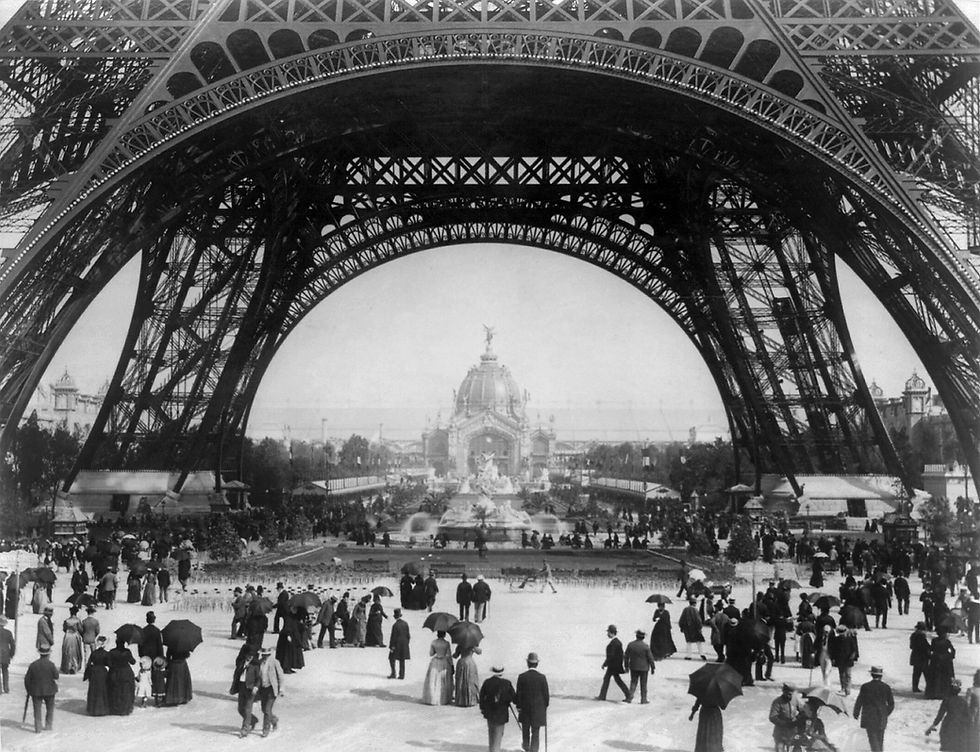
Architecture and engineering were central to this message. The exhibition’s most prominent structure was the Eiffel Tower, designed by Gustave Eiffel. Rising over 300 meters, the tower served as both an entrance marker and a powerful symbol of modern engineering. Conceived as a temporary structure, it nonetheless redefined the skyline of Paris and demonstrated the expressive potential of iron construction at unprecedented scale.
Complementing the tower was the Galerie des Machines, designed by Ferdinand Dutert and Victor Contamin. Its vast, unobstructed interior space showcased industrial machinery and technological systems, reinforcing the exhibition’s emphasis on production, performance and engineering innovation.
International participation was extensive. Thirty-five participants, including countries and colonies, presented industrial products, scientific instruments, decorative arts and cultural displays. National sections allowed visitors to compare technological capabilities and aesthetic approaches across regions, reinforcing the exhibition’s role as a comparative international platform.
Exhibits emphasized electricity, transportation, metallurgy and mechanical engineering, reflecting emerging systems that would shape urban and industrial life in the decades to come. Electric lighting featured prominently throughout the site, transforming the visitor experience and underscoring the growing role of electricity as a symbol of modernity. Artistic production remained integral, with painting, sculpture and decorative arts presented alongside industrial achievements.
Public engagement was a defining feature of Expo 1889 Paris. The exhibition attracted more than 32 million visits, making it one of the most attended international exhibitions of the century. The combination of monumental architecture, technological spectacle, and accessible public spaces reinforced the exhibition’s appeal to both specialist audiences and the general public.
Expo 1889 Paris left a lasting legacy. While many exhibition structures were dismantled after the event, the Eiffel Tower endured, becoming one of the most recognizable landmarks in the world. More broadly, the exposition demonstrated how architecture and engineering could function as central instruments of national representation within the evolving Expo tradition.
In this way, Expo 1889 Paris marked a shift toward symbolic monumentality within international exhibitions. It expanded the expressive possibilities of exhibition architecture and set new expectations for how host nations could communicate identity, ambition and technological confidence on a global stage.
The story
Celebration of the centenary of the French revolution
Marking the centenary of the French Revolution, Expo 1889 Paris gave the world the Eiffel Tower and the Galerie des Machines, and drew more than 32 million visits.
The site
Where it happened
RESOURCES


Add paragraph text. Click “Edit Text” to update the font, size and more. To change and reuse text themes, go to Site Styles.
RESOURCES
Add a Title
Add paragraph text. Click “Edit Text” to update the font, size and more. To change and reuse text themes, go to Site Styles.
Add a Title
Add paragraph text. Click “Edit Text” to update the font, size and more. To change and reuse text themes, go to Site Styles.
Add a Title
Add paragraph text. Click “Edit Text” to update the font, size and more. To change and reuse text themes, go to Site Styles.
RESOURCES

Add paragraph text. Click “Edit Text” to update the font, size and more. To change and reuse text themes, go to Site Styles.
Add paragraph text. Click “Edit Text” to update the font, size and more. To change and reuse text themes, go to Site Styles.
Add paragraph text. Click “Edit Text” to update the font, size and more. To change and reuse text themes, go to Site Styles.
Sources
International Exhibitions Bureau, Exposition Universelle de 1889 Parishttps://www.bie-paris.org/site/en/1889-paris
Encyclopaedia Britannica, Paris Exposition of 1889 https://www.britannica.com/event/Paris-Exposition-of-1889
Musée d’Orsay, The Universal Exhibition of 1889 https://www.musee-orsay.fr/en/resources/archives/exposition-universelle-1889
Eiffel Tower, History of the Towerhttps://www.toureiffel.paris/en/the-monument/history