Past Expo
Expo 1910 Brussels
April 23 to November 7, 1910
Theme: Works of Art and Science, Agricultural and Industrial Products of All Nations
Pre-Convention
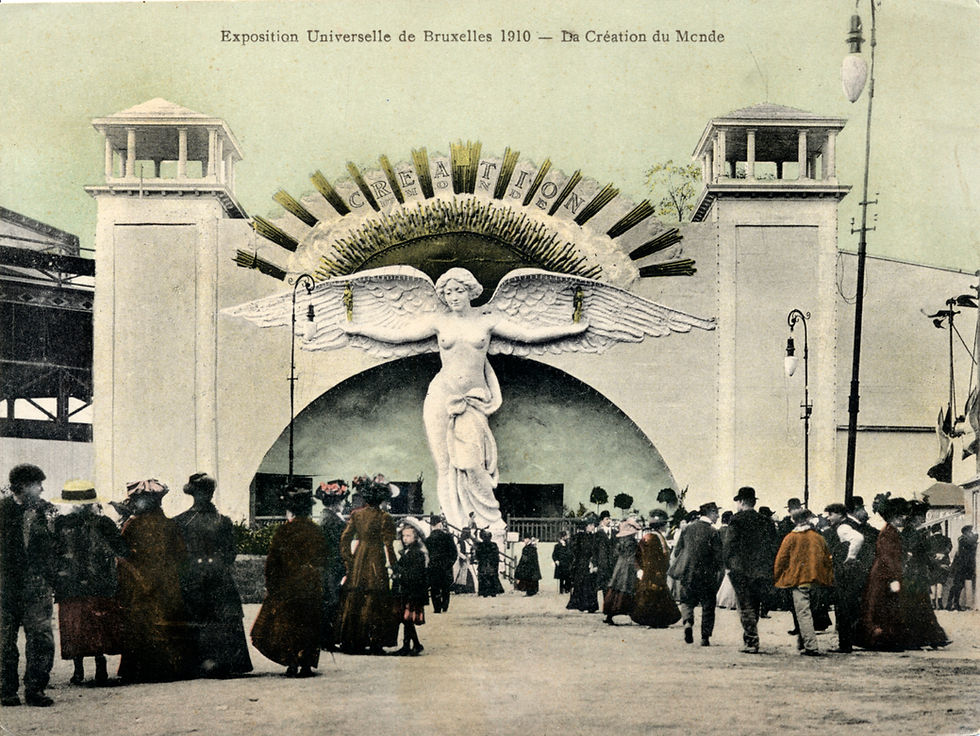
Photo: By Unknown author - Carte postale, Public Domain, https://commons.wikimedia.org/w/index.php?curid=4070169
Closed November 7, 1910
Add a Title
Add paragraph text. Click “Edit Text” to update the font, size and more. To change and reuse text themes, go to Site Styles.
Add a Title
Add paragraph text. Click “Edit Text” to update the font, size and more. To change and reuse text themes, go to Site Styles.
Add a Title
Add paragraph text. Click “Edit Text” to update the font, size and more. To change and reuse text themes, go to Site Styles.
115 years ago
199
Days open
26
Participating countries
90 ha
Exhibition site
222 acres
13M
Visits
13,000,000
65,327
Visits per day
average
Key facts
By the numbers
Official name
“Exposition Universelle et Internationale”
Category
Pre-Convention
Theme
Works of Art and Science, Agricultural and Industrial Products of All Nations
Dates
April 23 to November 7, 1910
199 days
Host city
Brussels, Belgium
Site
Solbos, Jubelpark, Tervuren
90 ha (222 acres)
Participating countries
26
Visits
13,000,000
At the height of the pre-World War I exhibition era, international expositions served as instruments of industrial display, cultural diplomacy and national prestige. By 1910, Brussels had established itself as a recurring host city within this global circuit, drawing on prior experience to stage an event of expanded scale and ambition.
Brussels reaffirmed this position in 1910. Officially titled “Exposition Universelle et Internationale de Bruxelles 1910,” Expo 1910 Brussels was held from April 23, 1910, to November 1, 1910, in Brussels, Kingdom of Belgium. Recognized by the International Exhibitions Bureau (Bureau International des Expositions, BIE) as a major international exposition, it was the third Expo hosted by the city, following the exhibitions of 1888 and 1897.
The exposition was conceived as a comprehensive presentation of contemporary progress. Rather than advancing a single unifying theme, it offered a broad survey of industry, science, fine arts and culture, reflecting the encyclopedic approach that characterized late 19th- and early 20th-century Expos. International cooperation and exchange were implicit objectives, expressed through comparative national displays and shared exhibition spaces.
The main exhibition site was located in the Solbosch district, on land that later became part of the Université libre de Bruxelles campus. Covering approximately 88 hectares, the grounds were laid out to accommodate national pavilions, exhibition halls, gardens and entertainment areas, integrating temporary architecture with planned circulation routes.
Participation was extensive. Twenty-six countries took part, including major European powers such as France, Germany, the United Kingdom and Russia, as well as the United States, Japan and several Latin American nations. Each participating country constructed its own pavilion, using architecture, industrial products, and cultural artifacts to project national identity and achievement.
Exhibits addressed a wide range of subjects. Industrial and technological displays highlighted advances in machinery, transportation and manufacturing processes. Fine arts occupied a prominent place, with exhibitions featuring contemporary artists from Belgium and abroad. A significant colonial section presented Belgium’s overseas possessions, particularly the Congo Free State, emphasizing raw materials, infrastructure and economic development. These displays reflected prevailing imperial perspectives of the period and have since become the subject of critical historical reassessment.
Architecture was dominated by elaborate temporary structures designed to impress through scale and ornamentation. The Grand Palais served as the principal exhibition hall, while national pavilions adopted stylistic references intended to convey cultural distinctiveness. Together, these buildings created a dense and visually varied exhibition landscape typical of prewar Expos.
Public engagement was strong. Expo 1910 Brussels attracted approximately 13 million visits during its six-month run, underscoring the continued appeal of international exhibitions to mass audiences. The event contributed to Brussels’s economic and cultural life and reinforced the city’s reputation as a capable host of large-scale international events.
Although most of the exhibition buildings were dismantled after closing, the exposition left a lasting imprint on the city’s development. The transformation of the Solbosch area and the experience gained in organizing the fair influenced subsequent exhibitions in Brussels, including Expo 1935 Brussels and Expo 58.
Within the Expo tradition, Expo 1910 Brussels represents a mature example of the prewar Expo. It combined international participation, industrial display, cultural production, and imperial representation at a moment when confidence in progress remained largely unchallenged, just a few years before global conflict would fundamentally reshape the exhibition landscape.
The story
Works of Art and Science, Agricultural and Industrial Products of All Nations
Expo 1910 Brussels gathered works of art and science and the products of many nations on the Solbosch site and drew about 13 million visits.
The site
Where it happened
RESOURCES
Add paragraph text. Click “Edit Text” to update the font, size and more. To change and reuse text themes, go to Site Styles.
Resources
Keep exploring Expo 1910 Brussels
Websites, archives, articles, data and media about this Expo, selected and reviewed by our curators.
1 resource
Book
Congresses at the Brussels Exposition: album published under the patronage…
De Rycker O. et Mendel, Bruxelles
Add paragraph text. Click “Edit Text” to update the font, size and more. To change and reuse text themes, go to Site Styles.
RESOURCES

Add paragraph text. Click “Edit Text” to update the font, size and more. To change and reuse text themes, go to Site Styles.
Add paragraph text. Click “Edit Text” to update the font, size and more. To change and reuse text themes, go to Site Styles.
Add paragraph text. Click “Edit Text” to update the font, size and more. To change and reuse text themes, go to Site Styles.
Bibliography
International Exhibitions Bureau. “Brussels 1910.” https://www.bie-paris.org/site/en/1910-brussels
Encyclopaedia Britannica. “Brussels International Exposition of 1910.” https://www.britannica.com/event/Brussels-International-Exposition-of-1910
Royal Museum for Central Africa. “Colonial Section at the 1910 Brussels World’s Fair.” https://www.africamuseum.be/en/research/collections_collections/history/exhibitions/1910_expo