Past Expo
Expo 1974 Spokane
May 4 to November 2, 1974
Theme: Progress without pollution
Special exhibition · First Categorization System
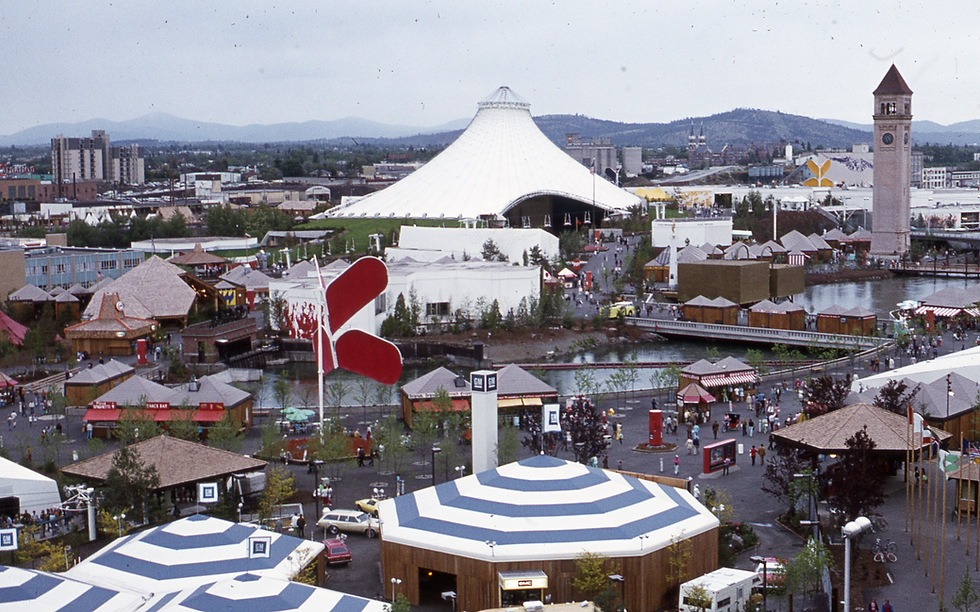
Photo: By Dormaier, Jacob, 1917-2007 - NWC 129, Dormaier, Jacob #164, Spokane Public Library (Jacob Dormaier Expo '74 Collection)https://lange.spokanelibrary.org/items/show/2426, CC0, https://commons.wikimedia.org/w/index.php?curid=90330339
Closed November 2, 1974
Add a Title
Add paragraph text. Click “Edit Text” to update the font, size and more. To change and reuse text themes, go to Site Styles.
Add a Title
Add paragraph text. Click “Edit Text” to update the font, size and more. To change and reuse text themes, go to Site Styles.
Add a Title
Add paragraph text. Click “Edit Text” to update the font, size and more. To change and reuse text themes, go to Site Styles.
52 years ago
183
Days open
10
Participating countries
40 ha
Exhibition site
99 acres
5.6M
Visits
5,600,000
30,601
Visits per day
average
Key facts
By the numbers
Official name
“Expo '74”
Category
Special exhibition
First Categorization System
Theme
Progress without pollution
Dates
May 4 to November 2, 1974
183 days
Host city
Spokane, United States of America
Site
Crystal Island (renamed "Canada Island" when it was officially deeded to Canada and used to host the British Columbia pavilion), Havermale Island, and the adjacent north and south banks of the Spokane River
40 ha (99 acres)
Host elected
November 24, 1971
Participating countries
10
Visits
5,600,000
The “International Exposition on the Environment, Spokane 1974,” widely known as Expo '74, was held in Spokane, Washington, United States, from May 4 to November 3, 1974. Organized by the Expo '74 Corporation, it was a special exhibition under the 1928 Paris Convention, recognized by the 70th General Assembly of the International Exhibitions Bureau (Bureau International des Expositions, BIE) on November 24, 1971. The BIE records 5.6 million visits.
The Expo grew out of a plan to reclaim the riverfront at Spokane Falls. The downtown business group Spokane Unlimited backed the effort, and King Cole, hired in 1963 to carry out an urban renewal plan, became its leading advocate after a 1970 feasibility study recommended an international exposition. Cole had consulted Joe Gandy, who had led Expo 1962 Seattle. Preparing the 40-hectare site on and around Havermale Island meant cleaning up the Spokane River, removing rail yards, and demolishing the 1902 Great Northern Railroad depot, except for its clock tower.
The theme, "Celebrating Tomorrow's Fresh New Environment," and the motto, "Progress without Pollution," placed the environment at the center of the Expo. Its emblem, a Möbius strip, represented the link between people and nature. President Richard M. Nixon opened the Expo before a crowd of about 85,000, and organizers released 1,974 trout into the Spokane River to show the river's recovery.
Ten countries took part: the United States, the Soviet Union, Japan, the Republic of China, the Republic of Korea, Canada, Australia, Iran, West Germany and the Philippines. The U.S. Pavilion, the largest on the grounds at 179,250 square feet, rose under a steel mast and a web of steel and vinyl. It presented one of the first IMAX films, “Man Belongs to the Earth,” and a wall quoting Chief Seattle: "The Earth does not belong to Man. Man belongs to the Earth." The Soviet pavilion gave many American visitors their first look at Soviet culture, Canada presented outdoor recreation on Canada Island, and Australia's pavilion featured an opera house modeled on the Sydney Opera House.
After the Expo, the grounds became Riverfront Park, dedicated by President Jimmy Carter on May 5, 1978, who said it "shows very clearly what can be accomplished in urban redevelopment." The Washington State Pavilion became the Spokane Opera House and Convention Center, while the clock tower and the U.S. Pavilion still stand in the park. In 2014, Spokane voters approved a $64 million bond to redevelop the park, including the U.S. Pavilion.
Expo 1974 Spokane turned an industrial riverfront into a public park and made the environment the subject of an Expo. Mayor David H. Rodgers summed it up: "Reduced to its essentials, we gave a great big party and the rest of the world came and paid the bill."
The story
Progress without pollution
Expo 1974 Spokane reclaimed the riverfront at Spokane Falls for an Expo on the environment and left Riverfront Park to the city.
The site
Where it happened
RESOURCES
Heritage
Traces you can visit today
The site today
Crystal Island (renamed "Canada Island" when it was officially deeded to Canada and used to host the British Columbia pavilion)
Add paragraph text. Click “Edit Text” to update the font, size and more. To change and reuse text themes, go to Site Styles.
Add paragraph text. Click “Edit Text” to update the font, size and more. To change and reuse text themes, go to Site Styles.
RESOURCES
Add a Title
Add paragraph text. Click “Edit Text” to update the font, size and more. To change and reuse text themes, go to Site Styles.
Add a Title
Add paragraph text. Click “Edit Text” to update the font, size and more. To change and reuse text themes, go to Site Styles.
Add a Title
Add paragraph text. Click “Edit Text” to update the font, size and more. To change and reuse text themes, go to Site Styles.
RESOURCES

Add paragraph text. Click “Edit Text” to update the font, size and more. To change and reuse text themes, go to Site Styles.
Add paragraph text. Click “Edit Text” to update the font, size and more. To change and reuse text themes, go to Site Styles.
Add paragraph text. Click “Edit Text” to update the font, size and more. To change and reuse text themes, go to Site Styles.
Bibliography
International Exhibitions Bureau. "Expo 1974 Spokane." BIE. https://www.bie-paris.org/site/en/1974-spokane
City of Spokane. "Riverfront Park History." City of Spokane, Washington. https://my.spokanecity.org/riverfrontspokane/about-us/history
Kershner, Jim. "Expo '74: Spokane World's Fair." HistoryLink.org. May 28, 2014. https://historylink.org/File/10791