Past Expo
Expo 1889 Paris
May 6 to October 31, 1889
Theme: Celebration of the centenary of the French revolution
Pre-Convention
Image: Photographer, collection, license
Closed October 31, 1889
Add a Title
Add paragraph text. Click “Edit Text” to update the font, size and more. To change and reuse text themes, go to Site Styles.
Add a Title
Add paragraph text. Click “Edit Text” to update the font, size and more. To change and reuse text themes, go to Site Styles.
Add a Title
Add paragraph text. Click “Edit Text” to update the font, size and more. To change and reuse text themes, go to Site Styles.
137 years ago
179
Days open
35
Participating countries
96 ha
Exhibition site
237 acres
32.3M
Visits
32,250,297
180,169
Visits per day
average
Add a Title
Add a Title
Add paragraph text. Click “Edit Text” to update the font, size and more. To change and reuse text themes, go to Site Styles.
Key facts
By the numbers
Official name
“Exposition universelle de 1889”
Category
Pre-Convention
Theme
Celebration of the centenary of the French revolution
Dates
May 6 to October 31, 1889
179 days
Host city
Paris, France
Site
Champ de Mars Trocadéro
96 ha (237 acres)
Participating countries
35
Visits
32,250,297
Commemoration
Centennial of the Storming of the Bastille
Overview
By the late 19th century, international exhibitions had become stages for symbolic assertion as much as platforms for industrial display. As nations competed to define modernity, hosts increasingly relied on architecture and engineering to communicate technological confidence and cultural leadership.
That ambition reached a defining expression in Paris in 1889. Officially titled “Exposition Universelle de 1889,” Expo 1889 Paris was held on the Champ de Mars and along the Seine from May 6 to October 31, 1889. The exhibition commemorated the centenary of the French Revolution and positioned France at the forefront of industrial innovation and artistic production at the close of the century.
Origins and organization
Organized by the French Third Republic, the exposition combined national commemoration with a forward-looking vision of progress. It sought to demonstrate the achievements of industry, science, and the arts while reaffirming Paris’s role as a global cultural capital within an increasingly competitive international exhibition landscape.
The site
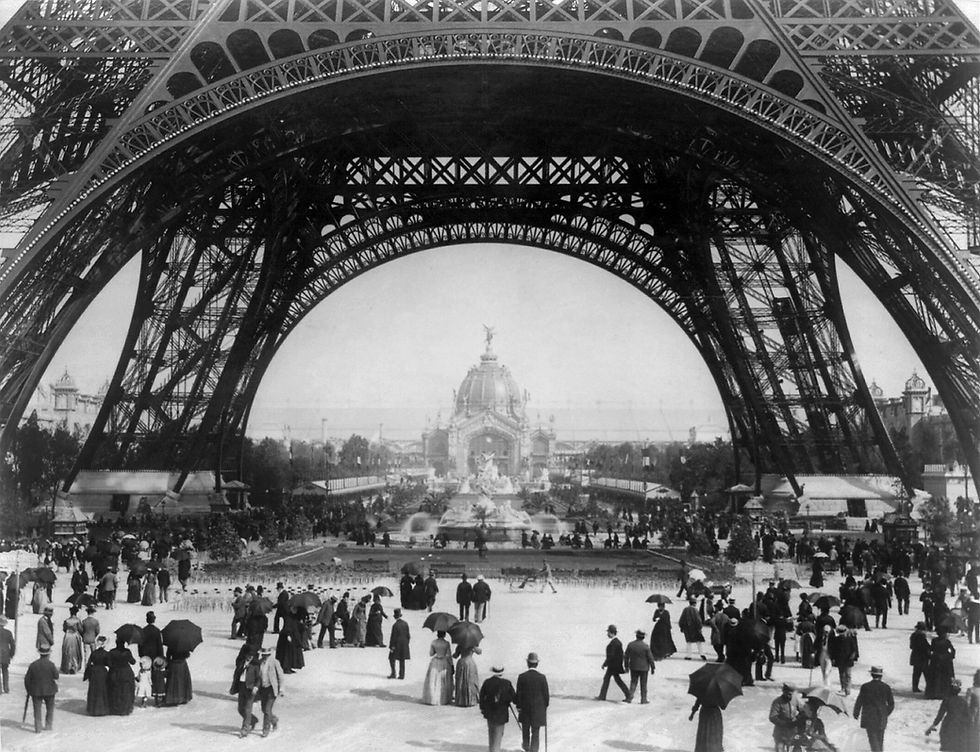
Architecture and engineering were central to this message. The exhibition’s most prominent structure was the Eiffel Tower, designed by Gustave Eiffel. Rising over 300 meters, the tower served as both an entrance marker and a powerful symbol of modern engineering. Conceived as a temporary structure, it nonetheless redefined the skyline of Paris and demonstrated the expressive potential of iron construction at unprecedented scale.
The idea came from two engineers at Eiffel’s firm, Maurice Koechlin and Émile Nouguier, in 1884, and the firm’s architect, Stephen Sauvestre, refined Koechlin’s sketch. Eiffel, Koechlin and Nouguier patented the system on September 18, 1884. The tower was built of puddled iron, not steel, from January 28, 1887, to March 31, 1889: five months for the foundations, which needed compressed-air caissons below the water table near the Seine, and 21 for the ironwork. About two and a half million rivets went into it, a third of them driven on site by teams of four, and its platforms stood at 57.63, 115.73 and 276.13 meters. It remained the tallest structure in the world for 42 years, until the Chrysler Building in New York (1930).
Complementing the tower was the Galerie des Machines, designed by Ferdinand Dutert and Victor Contamin. Its vast, unobstructed interior space showcased industrial machinery and technological systems, reinforcing the exhibition’s emphasis on production, performance and engineering innovation.
Its three-hinged iron arches spanned 110.6 meters (363 feet), the widest building span in the world at the time and more than 37 meters wider than St. Pancras Station in London. Sources give figures from 109 to 115 meters; architect Isaac López César settles on 110.6 meters from the plans published in 1891 by Eugène Hénard, who supervised the works. Although it is often described as steel, the building was almost entirely wrought iron: Hénard lists about 12,360 tonnes of iron against 155 tonnes of steel. The hall had no cast iron, and its design set the pattern for railway stations in Europe and the United States, where three-hinged spans doubled from about 50 to 100 meters after 1889.
International participation
International participation was extensive. Thirty-five participants, including countries and colonies, presented industrial products, scientific instruments, decorative arts and cultural displays. National sections allowed visitors to compare technological capabilities and aesthetic approaches across regions, reinforcing the exhibition’s role as a comparative international platform.
Countries of America brought their own images of themselves to Paris. Performance scholar Ruth Hellier-Tinoco notes that the Mexican pavilion represented an Aztec palace, adorned with bronze statues of Aztec gods, goddesses and kings, a “statement about Mexico’s Indian legacy in an era of science and nationalism,” in the words she quotes. She traces to such 19th-century displays the past, present and future formula that Mexico still used more than a century later, at Expo 2000 Hannover. From the United States came William “Buffalo Bill” Cody’s Wild West, which, as scholar Constance Crompton notes, proved popular in Paris that year, four years before it set up beside the Midway at Expo 1893 Chicago.
Colonial and ethnographic displays
The colonial section on the Esplanade des Invalides gave the French government, then facing parliamentary opposition to colonial expansion, a stage for its empire. Drawing on historian Lynn E. Palermo, scholar Fanny Robles describes a hierarchy built into its layout: buildings representing the North African and Asian colonies lined the main alley, while villages presenting sub-Saharan Africans, Kanaks from New Caledonia and people from Tonkin were scattered around them. One village housed more than 30 Senegalese brought to Paris by the colonial officer Commandant Noirot. Robles argues that the villages served as a symbolic counterpoint to the Eiffel Tower; the journalist Henri Anry, seeing the Senegalese eat and sleep on the ground, remarked that these were not people who would have built it.
Among the villagers was the jeweler Samba Laobé Thiam of Saint-Louis, who ran a workshop on the esplanade with his brother and young son. He told a journalist that the Senegalese felt humiliated to be exhibited “in huts like savages,” since straw and mud huts gave no idea of a country with large buildings, railways and electric lighting. The same journalist recorded the insults visitors hurled at the people behind the fences. Decades later, the writer Louise Faure-Favier, who had marked his name in her copy of Louis Rousselet’s account of the Expo, gave him a role in her novel “Blanche et Noir” (1928), in which a provincial widow meets a man from the Senegalese village at Expo 1889 Paris and follows him to Senegal.
The Senegalese village drew on a Parisian tradition of human display. Robles notes that Henri Anry, describing it for the Expo’s “Livre d’Or,” spoke of a “transplantation,” a word that recalls the Jardin Zoologique d’Acclimatation in the Bois de Boulogne. The garden had shown a group of Nubians alongside African animals in 1877, and its attendance rose from 606,979 in 1875 to 830,711 in 1877; scholar Aaron Santesso notes that the organizers of the 1889 colonial displays cooperated with it. Anry, whom Robles reads through historian Brett A. Berliner’s idea of “ethno-eroticism,” praised the looks of the Senegalese men and suggested the jewelers could open a shop on the boulevards after the Expo. Prince Roland Bonaparte owned a set of 24 anthropological photographs of the village.
The Expo also changed how an American museum displayed people. Art historian Kathleen Curran shows that Otis T. Mason, curator of ethnology at the Smithsonian Institution’s United States National Museum, traveled to Paris in 1889 and saw the exhibit on the history of human habitation on the Champ de Mars: full-scale houses, complete with furniture and life-size figures, that traced human dwellings from prehistoric times to the present. Back in Washington, Mason reported in September 1890 a “fresh start” in making life-size figures of Indigenous peoples. The work led to the Smithsonian’s life groups, which made their debut at Expo 1893 Chicago with scenes such as Navajo women weaving blankets.
Exhibitions
Exhibits emphasized electricity, transportation, metallurgy and mechanical engineering, reflecting emerging systems that would shape urban and industrial life in the decades to come. Electric lighting featured prominently throughout the site, transforming the visitor experience and underscoring the growing role of electricity as a symbol of modernity. Artistic production remained integral, with painting, sculpture and decorative arts presented alongside industrial achievements.
Visitors and services
Public engagement was a defining feature of Expo 1889 Paris. The exhibition attracted more than 32 million visits, making it one of the most attended international exhibitions of the century. The combination of monumental architecture, technological spectacle, and accessible public spaces reinforced the exhibition’s appeal to both specialist audiences and the general public.
Meals at the Expo revealed its social divisions. Historian Van Troi Tran cites the journalist Vital Meurysse, who observed that millionaires dined in the restaurants of the Eiffel Tower at extravagant prices, people of modest means queued at the inexpensive Duval restaurants and ordinary Parisians ate outdoors. Groups unpacked bread, charcuterie and wine on makeshift tables, lawns and benches, especially on crowded Sundays, and the cartoonist Henriot drew picnickers perched on statue pedestals and talking back to a bewildered policeman. Not everyone was amused. The chef Auguste Escoffier complained that the Expo’s paths had become refectories and its lawns dining rooms, scenes he judged unworthy of Paris as a capital of taste and cuisine.
Legacy
Expo 1889 Paris left a lasting legacy. While many exhibition structures were dismantled after the event, the Eiffel Tower endured, becoming one of the most recognizable landmarks in the world. More broadly, the exposition demonstrated how architecture and engineering could function as central instruments of national representation within the evolving Expo tradition.
The tower and the Galerie des Machines became reference points for later Expos. Historian Stephen J. Whitfield calls the Ferris wheel of Expo 1893 Chicago the counterpart of Eiffel’s “bizarre but very durable” structure. The modernist historian Sigfried Giedion saw in the Galerie des Machines “a volume of free space” that amounted to “an entirely unprecedented conquest of matter,” and architectural historian Inderbir Singh Riar shows that the planners Daniel van Ginkel and Blanche Lemco van Ginkel invoked both works when shaping Expo 1967 Montreal. Anthropologist Scott A. Lukas counts the tower, with later landmarks such as the Space Needle and Habitat 67, among the symbolic Expo buildings whose use of architecture theme parks would come to share.
In this way, Expo 1889 Paris marked a shift toward symbolic monumentality within international exhibitions. It expanded the expressive possibilities of exhibition architecture and set new expectations for how host nations could communicate identity, ambition and technological confidence on a global stage.
The story
Celebration of the centenary of the French revolution
Marking the centenary of the French Revolution, Expo 1889 Paris gave the world the Eiffel Tower and the Galerie des Machines, and drew more than 32 million visits.
The site
Where it happened
RESOURCES


Heritage
Traces you can visit today
Add a Title
Add paragraph text. Click “Edit Text” to update the font, size and more. To change and reuse text themes, go to Site Styles.
Add a Title
Add paragraph text. Click “Edit Text” to update the font, size and more. To change and reuse text themes, go to Site Styles.
Add a Title
Add paragraph text. Click “Edit Text” to update the font, size and more. To change and reuse text themes, go to Site Styles.
Add paragraph text. Click “Edit Text” to update the font, size and more. To change and reuse text themes, go to Site Styles.
Add paragraph text. Click “Edit Text” to update the font, size and more. To change and reuse text themes, go to Site Styles.
Add paragraph text. Click “Edit Text” to update the font, size and more. To change and reuse text themes, go to Site Styles.
RESOURCES
Add a Title
Add paragraph text. Click “Edit Text” to update the font, size and more. To change and reuse text themes, go to Site Styles.
Add a Title
Add paragraph text. Click “Edit Text” to update the font, size and more. To change and reuse text themes, go to Site Styles.
Add a Title
Add paragraph text. Click “Edit Text” to update the font, size and more. To change and reuse text themes, go to Site Styles.
RESOURCES

Add paragraph text. Click “Edit Text” to update the font, size and more. To change and reuse text themes, go to Site Styles.
Add paragraph text. Click “Edit Text” to update the font, size and more. To change and reuse text themes, go to Site Styles.
Add paragraph text. Click “Edit Text” to update the font, size and more. To change and reuse text themes, go to Site Styles.
■■■■■ Reliability: Tier 1, Reference grade
You can cite Expomuseum. For a specific figure, you may also cite the source we list for it.
Rated November 12, 2026 · 92 / 100 · How we choose sources and rate this page
Bibliography
Bureau International des Expositions. “Exposition Universelle de 1889 Paris.” https://www.bie-paris.org/site/en/1889-paris
Crompton, Constance. “Staging Gentility at the Columbian Exposition: Masculinity on and off the Midway.” In Meet Me at the Fair: A World’s Fair Reader, edited by Laura Hollengreen, Celia Pearce, Rebecca Rouse, and Bobby Schweizer, 113–26. Play Story Press, 2025. First published 2014 by ETC Press. https://doi.org/10.17613/47rhk-v4881
Curran, Kathleen. “Displaying Cultural History: The Smithsonian Institution and the World’s Fairs.” In Meet Me at the Fair: A World’s Fair Reader, edited by Laura Hollengreen, Celia Pearce, Rebecca Rouse, and Bobby Schweizer, 31–40. Play Story Press, 2025. First published 2014 by ETC Press. https://doi.org/10.17613/47rhk-v4881
Encyclopaedia Britannica. “Paris Exposition of 1889.” https://www.britannica.com/event/Paris-Exposition-of-1889
Hellier-Tinoco, Ruth. “Embodying Touristic Mexico: Virtual and Erased Indigenous Bodies.” In Meet Me at the Fair: A World’s Fair Reader, edited by Laura Hollengreen, Celia Pearce, Rebecca Rouse, and Bobby Schweizer, 71–82. Play Story Press, 2025. First published 2014 by ETC Press. https://doi.org/10.17613/47rhk-v4881
López César, Isaac. World Expos: A History of Structures. Translated by Rebecca S. Ramanathan. Barberà del Vallès, Barcelona: By Architect Publications, 2017.
Lukas, Scott A. “How the Theme Park Got Its Power: The World’s Fair as Cultural Form.” In Meet Me at the Fair: A World’s Fair Reader, edited by Laura Hollengreen, Celia Pearce, Rebecca Rouse, and Bobby Schweizer, 395–408. Play Story Press, 2025. First published 2014 by ETC Press. https://doi.org/10.17613/47rhk-v4881
Musée d’Orsay. “The Universal Exhibition of 1889.” https://www.musee-orsay.fr/en/resources/archives/exposition-universelle-1889
Riar, Inderbir Singh. “Expo 67, or Megastructure Redux.” In Meet Me at the Fair: A World’s Fair Reader, edited by Laura Hollengreen, Celia Pearce, Rebecca Rouse, and Bobby Schweizer, 255–70. Play Story Press, 2025. First published 2014 by ETC Press. https://doi.org/10.17613/47rhk-v4881
Robles, Fanny. “Blanche et Noir, by Louise Faure-Favier: When France Falls in Love with Senegal at the 1889 Exposition Universelle in Paris.” In Meet Me at the Fair: A World’s Fair Reader, edited by Laura Hollengreen, Celia Pearce, Rebecca Rouse, and Bobby Schweizer, 53–60. Play Story Press, 2025. First published 2014 by ETC Press. https://doi.org/10.17613/47rhk-v4881
Santesso, Aaron. “Living Authenticity: The World’s Fair and the Zoo.” In Meet Me at the Fair: A World’s Fair Reader, edited by Laura Hollengreen, Celia Pearce, Rebecca Rouse, and Bobby Schweizer, 41–52. Play Story Press, 2025. First published 2014 by ETC Press. https://doi.org/10.17613/47rhk-v4881
Société d’Exploitation de la Tour Eiffel. “History of the Tower.” https://www.toureiffel.paris/en/the-monument/history
Tran, Van Troi. “A History of Picnics at World’s Fairs.” In Meet Me at the Fair: A World’s Fair Reader, edited by Laura Hollengreen, Celia Pearce, Rebecca Rouse, and Bobby Schweizer, 435–46. Play Story Press, 2025. First published 2014 by ETC Press. https://doi.org/10.17613/47rhk-v4881
Whitfield, Stephen J. “Frontiers of the World’s Columbian Exposition.” In Meet Me at the Fair: A World’s Fair Reader, edited by Laura Hollengreen, Celia Pearce, Rebecca Rouse, and Bobby Schweizer, 83–96. Play Story Press, 2025. First published 2014 by ETC Press. https://doi.org/10.17613/47rhk-v4881
How to cite this page
Expomuseum. “Expo 1889 Paris.” Accessed November 23, 2026. https://www.expomuseum.com/expos/expo-1889-paris.